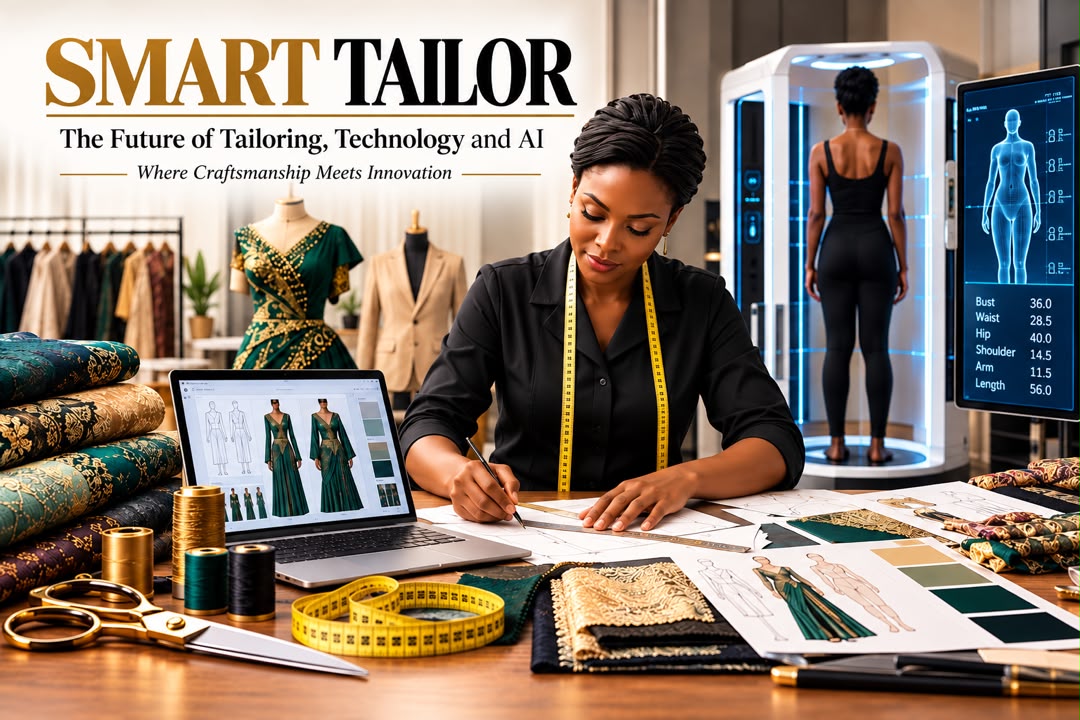
The Future of Tailoring, Technology, Creativity and AI
Have you ever wondered what the future of fashion and tailoring will look like?
Will the tailor of the future still depend only on a measuring tape, scissors and sewing machine? Or will technology, digital tools and artificial intelligence become part of the tailor's everyday work?
The tailor of the future will not simply be a person who makes clothes. The smart tailor will be a combination of craftsmanship, fashion, technology, creativity, business and customer understanding.
The Tailor Is Becoming More Than a Tailor
Today, tailoring is often associated mainly with cutting, sewing and fitting garments. But the industry is changing.
The tailor of the future will need to understand much more than how to operate a sewing machine. He or she will need knowledge of fabrics, garment construction, fashion trends, design, measurements, customer preferences, technology, communication and business management.
The tailor will gradually become a fashion consultant—someone who does not simply make what the customer asks for, but understands the customer's needs and helps the customer make better fashion decisions.
For example, if a customer brings a particular design, the smart tailor should be able to look at the design and consider:
- Is the design suitable for the customer's body shape?
- Is the fabric appropriate for the style?
- Will the fabric give the desired structure and fitting?
- Can the design be improved?
- Is the design practical to manufacture?
- What adjustments will produce a better result?
This is where craftsmanship and professional knowledge become extremely important.
The Measuring Tape Will Not Disappear—But It Will Evolve
Today, we take measurements using a measuring tape.
Tomorrow, digital measurement, body scanning and other technologies may make the process faster and more precise.
A customer could potentially have their measurements digitally recorded and stored in a customer profile. When that customer returns months or even years later, the tailor may already have access to their previous measurements, fitting preferences, garment history and style information.
Imagine a customer returning to your business and you are able to say:
“Would you like the same fitting you had last time?”
Or:
“Your previous measurement is already on your profile. Would you like us to use it, or would you like us to update it?”
That is more than measurement.
That is smart customer service.
Technology can collect measurements, store information and make processes faster. But technology alone cannot completely understand the customer.
The tailor still needs the human ability to observe, listen, ask questions and understand what the customer really wants.
The Customer Will Become a Digital Customer
The smart tailor of the future will not exist only inside a workshop.
The business will also exist digitally.
Customers will discover the tailor through:
- Websites
- Digital catalogues
- Social media
- Online consultations
- Digital portfolios
- Customer databases
A tailor's work will no longer be seen only by people who physically visit the shop.
Your work can travel further than you can.
A garment made in your workshop today could be seen by a customer tomorrow in another city—or even another country.
This means that the modern tailor must learn how to present, document and market their work digitally.
AI Will Become the Tailor's Assistant
And now comes one of the biggest changes: Artificial Intelligence.
AI can help a tailor generate design ideas, explore colour combinations, create mood boards, develop marketing content, organise information, prepare social media posts and assist with customer communication.
But there is an important principle we must understand:
AI should be your assistant—not your replacement.
A tailor who knows how to use AI effectively can increase creativity and productivity.
For example, instead of spending hours trying to develop different design concepts, a tailor can use AI to explore several possibilities and then apply professional tailoring knowledge to determine what will actually work.
AI can suggest.
The tailor decides.
AI can generate.
The tailor creates.
AI can assist.
The tailor remains the craftsman.
Technology Cannot Replace Skill
Imagine a customer brings a beautiful design but chooses a fabric that is unsuitable for the structure of the garment.
An inexperienced tailor might simply say:
“Yes, we can make it.”
But the smart tailor will look deeper.
The tailor may explain:
“This design can work, but this particular fabric may not give you the structure you want. I recommend another fabric or a modification to the design.”
That conversation demonstrates something technology cannot replace easily:
professional judgement.
The future will not belong simply to the tailor who owns the most advanced machine.
It will belong to the tailor who knows how, when and why to use technology.
Customer Information Will Become an Asset
In the future, customer information will become extremely valuable.
A smart tailoring business can maintain a digital customer profile containing information such as:
- Body measurements
- Previous garments
- Preferred fitting
- Favourite colours
- Preferred fabrics
- Style preferences
- Previous orders
- Alterations
- Delivery history
- Important customer notes
When a customer returns, the tailor does not have to start from zero.
The business already knows the customer.
This creates a more personalised experience.
The customer begins to feel:
“They know me.”
And that is one of the foundations of strong customer relationships.
From Tailor to Brand
There is another major change coming.
The future tailor will not only ask:
“How many clothes can I sew today?”
The tailor will also ask:
“What brand am I building?”
There is a difference between being known as someone who makes clothes and building a recognised fashion brand.
A brand has:
- A name
- A visual identity
- A unique style
- Consistent quality
- A customer experience
- A reputation
- A story
- A recognizable identity
When customers begin to recognise your work before they even see your name, something important has happened.
Your craftsmanship has become your identity.
Speed Will Matter—But Quality Will Matter More
In the future, customers will expect more than a beautiful garment.
They will expect:
Good quality.
Good communication.
Accurate measurements.
Professional fitting.
Reliable delivery.
Good customer service.
Consistency.
This means that the smart tailor will need systems.
Measurements should be organised.
Orders should be tracked.
Production should be monitored.
Workers should know their responsibilities.
Delivery dates should be recorded.
Customer information should be accessible.
The future of tailoring is therefore not only about machines.
It is also about systems.
The Smart Tailor Will Connect Craftsmanship With Technology
Technology will continue to develop.
Digital measurement will improve.
Body scanning will become more accessible.
AI will become more powerful.
Design software will become more sophisticated.
Production management will become more digital.
New machines will continue to enter the garment industry.
But one thing will remain valuable:
The skill of the tailor.
Two tailors may have the same machine.
Two designers may use the same AI tool.
Two businesses may have access to the same digital technology.
Yet the results can still be completely different.
Why?
Because technology is a tool. Skill is what gives the tool value.
The Tailor of Tomorrow Must Start Learning Today
The tailor who waits until technology becomes unavoidable may struggle to adapt.
But the tailor who begins learning today will have time to understand how technology can strengthen their craft.
Learn fashion.
Learn fitting.
Learn fabrics.
Learn garment construction.
Learn digital design.
Learn customer service.
Learn business.
Learn AI.
Learn how to use technology without losing the craftsmanship that made tailoring valuable in the first place.
The future does not require us to choose between the tailor and technology.
The future requires us to combine them.
The Future of Tailoring
The tailor of tomorrow may take measurements digitally, design with advanced software, use AI for creative support, manage customers through a digital platform, track production electronically and communicate with customers through a mobile phone.
Yet behind all these technologies, there will still be a person who understands:
fabric, fit, proportion, construction, creativity and the customer.
That is the Smart Tailor.
The Smart Tailor is not afraid of technology.
The Smart Tailor learns it.
The Smart Tailor does not allow AI to replace creativity.
The Smart Tailor uses AI to expand creativity.
The Smart Tailor does not abandon traditional craftsmanship.
The Smart Tailor combines craftsmanship with innovation.
The future belongs to the tailor who can combine skill, creativity, technology, customer understanding and business intelligence.
The measuring tape may become digital.
The sewing machine may become smarter.
AI may become more powerful.
But the value of the skilled tailor will remain.
Technology will change the way we tailor.
Skill will determine what we create.